
Appendix D: Complex numbers#
Properties of complex numbers#
Imaginary Numbers#
The square root of a negative real number is referred to as an imaginary number. So \(\sqrt{-2}\), \(\sqrt{-5}\) and \(\sqrt{-11}\) are all imaginary numbers. The unit of imaginary numbers is \(\sqrt{-1}\) and is usually denoted by the letter \(i\). To avoid confusion with the current \(i\) in electronics, the letter \(j\) is used. So
Complex numbers#
A complex number is a number of the form
where \(x\) and \(y\) are real numbers. The variables \(x\) and \(y\) are the real (Re\(z\)) and the imaginary (Im\(z\)) component of \(z\) respectively. The complex number \(z\) can also be written as:
In fact a complex number has two coordinates and can be graphically displayed as a point in a plane, the complex plane. This rectangular or the Cartesian coordinates are plotted along the real and the imaginary axis (see Fig. 154).
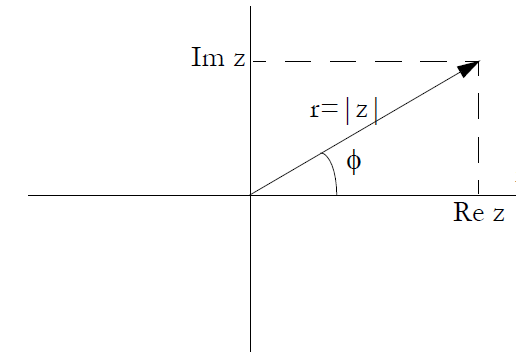
Fig. 154 Complex plane#
A complex number can also be represented in a polar notation:
where:
is the length of the vector (\({\rm Re } \, z\), \({\rm Im} \, z\)), also known as the modulus of \(z\), and:
is the angle this vector makes with the positive real axis, with \(k\) as an integer, also known as the argument of \(z\).
Note
The \(\pm k \cdot \pi\) has to do with the fact that \(\varphi\) is a continuous quantity, in principle with a range of \(-\infty\) and \(+\infty\), while the function \(tan^{-1}\) is defined for the interval \(-\pi/2\) to + \(\pi/2\).
The inverse transformation from polar coordinates to Cartesian coordinates is given by:
A third way to express a complex number is to make use of the complex exponential function:
where:
Using the above definitions, and relationships we can derive some rules.
For addition and subtraction:
for multiplication:
for division: